Contents
- 1 What are chestnuts good for?
- 1.1 PROPERTIES OF CHESTNUTS
- 1.2 Nutritional value of chestnuts
- 1.3 Benefits of Eating Chestnuts
- 1.4 Vitamins and minerals of chestnuts
- 1.5 Chestnuts as a physical restorative
- 1.6 Carbohydrates in chestnusts
- 1.7 Advantages and benefits of eating chestnuts
- 1.8 Advantages of carbohydrates versus fats
- 1.9 Is it bad to eat foods with carbohydrates?
- 1.10 Complex carbohydrates versus simple carbohydrates
- 1.11 How many calories do the chestnuts have?
- 1.12 Are chestnuts fattening?
- 1.13 Cooked chestnuts for constipation and for diarrhea
- 1.14 Are chestnuts a little digestive fruit?
- 1.15 Can you eat raw chestnuts?
- 1.16 Chestnuts are rich in potassium and vitamin B
- 1.17 Chestnuts for pregnant women and women in lactation
- 1.18 Can diabetics eat chestnuts?
- 1.19 Anti-prostatic properties of chestnuts
- 1.20 CHESTNUTS IN FOOD
- 1.21 Importance of chestnuts as food
- 1.22 How to cook chestnuts?
- 1.23 How to eat chestnuts
- 1.24 Boiled chestnuts
- 1.25 Chestnuts as a garnish of different recipes
- 1.26 What are “pilongas”chestnuts or dried chestnuts?
- 1.27 How are “pilongas” chestnuts prepared?
- 1.28 HOW TO BUY THE BEST CHESTNUTS
- 1.29 Selecting and buying chestnuts
- 1.30 How to store and preserve chestnuts
- 1.31 Can chestnuts be frozen?
What are chestnuts good for?
PROPERTIES OF CHESTNUTS
Nutritional value of chestnuts
Chestnuts (Castanea sativa) are a type of dry fruit with special characteristics, because unlike others, such as almonds or walnuts, chestnuts are very rich in carbohydrates (40%) and contain few fats (2%). and proteins (2%).
Dr. W. Heupke, a prestigious German physician, describes chestnuts as “the small loaves provided by nature”.
Benefits of Eating Chestnuts
The cooked fruits are very nutritious and easy to digest, provide lasting energy and satiating fiber (5%) to work, play or study throughout the day without having to eat between hours.
Boiled, chestnuts have demulcent properties suitable for irritated stomachs (gastritis, ulcers, etc.) and is recommended for intestinal disorders such as diarrhea.
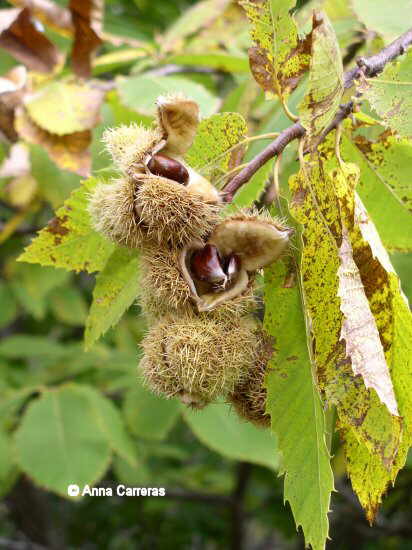 Leaves and fruits of chestnut, the tree that gives the chestnuts
Vitamins and minerals of chestnuts
Consuming chestnuts has a nutritional value similar to that of whole grains, with the advantage that, because they are not refined, they contain all the vitamins and fibers.
Chestnuts provide many B-complex vitamins, such as thiamine (B1), niacin (B3), pyridoxine (B6) and folates (B9). Of minerals, it emphasizes its content in potassium and iron.
All these vitamins are important for energy metabolism, ie good doses of these vitamins are needed to improve brain and physical performance (students at test times, children, adults and seniors).
Chestnuts as a physical restorative
Chestnuts are recommended for states of physical and mental decay, weakness, fatigue and lack of energy, as a nutritious food and easy to digest. It is considered a restorative food that nourishes, comforts and provides energy of good quality.
Carbohydrates in chestnusts
Almost half of the composition of chestnuts is made up of carbohydrates.
This makes chestnuts an ideal energy food to calm hunger in the cool days of autumn when the fruit is collected or sold roasted on the streets, in winter.
We might think that chestnuts make us get very fat and we may be tempted not to eat them not to become fat or in case of weight-loss diets.
Advantages and benefits of eating chestnuts
Actually, chestnuts are one of the less caloric nuts, because its fat content is very low and also due to the the great amount of water it contains. When compared with walnuts, the difference is really big. The latter have three times more calories, only 4% water, 60% fat and is very low in carbohydrates (less than 14%). This does not mean that walnuts are bad.
On the contrary, their wealth in polyunsaturated vegetable oils makes them a natural medicine, although it is true that, at equal weight, nuts, like all other dried fruits, are much more fattening than chestnuts.
Advantages of carbohydrates versus fats
We must not forget the role that carbohydrates play in the diet. Carbohydrates should be considered as the most important energy source. Unfortunately, in recent times the trend has been the contrary.
Because of misinformation, many starchy foods such as wheat, potatoes or rice, have attained a very bad reputation in Western countries and in many developing ones. So, they have been substituted for fats.
The calorific value of fat is more than twice that of carbohydrates (just 9 calories per gram in fat and 4 kilocalories per gram in carbohydrates). Therefore, if we eat the same quantity of fat than carbohydrates, we will ingest double calories eating fatty food than if we eat carbs. Besides, most of fats we take are from the saturated type, which are responsible for the appearance of numerous diseases of the circulatory system.
On the other hand, one should not forget that carbohydrates constitute the unique fuel with which the brain can work once the body breaks them down into glucose. A diet deficient in carbohydrates may be responsible for the appearance of numerous anomalies, such as nervousness, anxiety, lack of attention, etc.
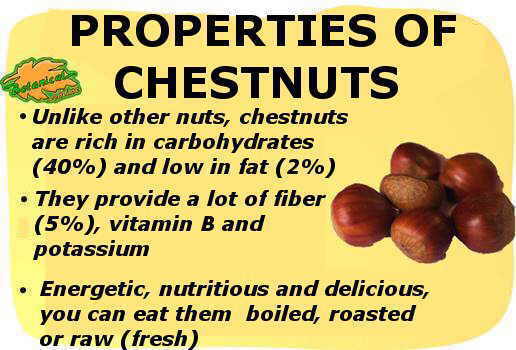
Main nutritional properties of chestnuts. They are very energetic and nutritious, as well as delicious. Consult the article on the raw, roasted and boiled properties
Is it bad to eat foods with carbohydrates?
As a result of bad information, many starchy foods, such as oats, potatoes, sweet potatoes or rice, have accumulated very bad reputation in Western countries and in many developing countries they have been replaced by fatty food..
The caloric power of fats is more than double that of hydrates (exactly 9 kilocalories per gram in fats and 4 kilocalories per gram in hydrates) and, therefore, eat the same weight in fats that in carbohydrates makes you fatter. All this without considering that often the fats are of the saturated type and are responsible for the appearance of numerous diseases of the circulatory system.
Complex carbohydrates versus simple carbohydrates
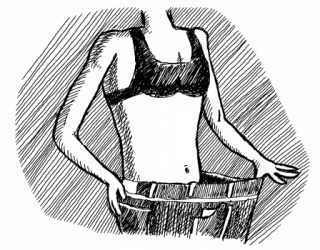 Many people do not eat chestnuts because they think they are fattening. Properly eaten, because of their richness in complex carbohydrates, they can even be of help in diets for weight loss.
On the other hand, it should not be forgotten that carbohydrates are the main fuel with which the brain can function once the body breaks them down into glucose, which the brain uses to feed itself.
Poor nutrition in hydrates can be responsible for the appearance of numerous anomalies, such as nervousness, anxiety, lack of attention, etc. Also, dispensing with the nutrients provided by these nutrients produces impoverishment of the intestinal flora
A very strict diet of complex carbohydrates (those that are provided by starches, cereals, legumes or certain foods such as chestnuts) or a strict diet based on simple carbohydrates (those provided by fruit or candy) is responsible for hypoglycemia leading to a state of weakness and general apathy.
Within the group of carbohydrates, the complex carbohydrates are the most interesting because they release glucose more slowly in the blood stream and allow the brain and the body in general to keep its energy in a controlled way for longer.
How many calories do the chestnuts have?
Eating a typical serving of roasted chestnuts, about 12 units, provides the following nutrients, carbohydrates, proteins, fibers, vitamins and minerals:
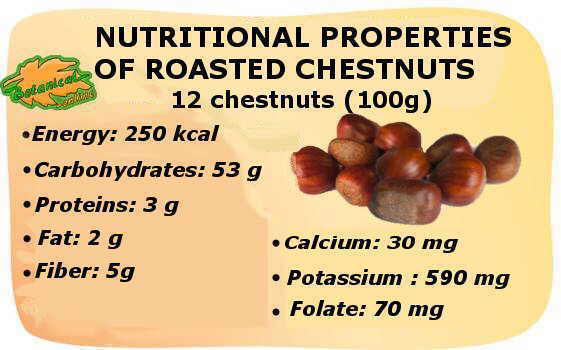
Nutrients that roasted chestnuts provide: calories, carbohydrates, proteins and minerals. In general they are rich in vitamins B (see table)
Are chestnuts fattening?
Chestnuts are rich in complex carbohydrates which can be absorbed by the body in a slow way, so they help keep sugar levels balanced and remove the feeling of hunger for a long time.
A handful of roasted or cooked chestnuts can help avoid eating other foods high in fat and therefore, when eaten in moderation, they can help you to lose weight.
They are ideal for sportsmen, children in growth period or hard physical workers.
Its high fiber content makes them very interesting to prevent constipation and to favor the expulsion of feces.
* More information: Chestnuts for loosing weight
Cooked chestnuts for constipation and for diarrhea
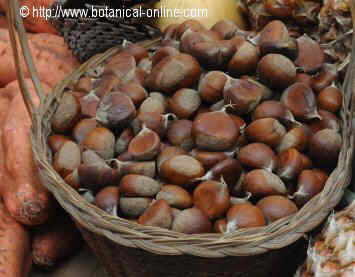 Raw chestnuts
Its high fiber content (5%) makes them very interesting to avoid constipation and encourage the expulsion of feces. They contain many fibers that help to improve the intestinal flora and to regulate the transit.
In addition, chestnuts are highly recommended also in periods of diarrhea, especially in the form of puree.
To do this they must be cut with the knife, then boiled in plenty of water, with cinnamon and seeds of fennel or anise, and, when they are well cooked and moisturized, the peel and brown skin are removed and crushed to form a uniform mass. It has a mild astringent effect, it is nutritious and helps to cut the diarrhea.
Are chestnuts a little digestive fruit?
Chestnuts have always been known to be very hard to digest. This thought is partly justified. The digestion of a food so rich in carbohydrates requires a good salivation, so they should be chewed carefully so that they can be digested well. It is not advisable to eat them raw or very dry, for example roasted, if you do not chew and salivate them well.
Can you eat raw chestnuts?
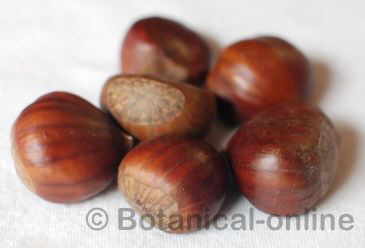 Photo of raw chestnuts. Can you eat them raw?
Chestnuts can be eaten raw when they are very tender. We should not forget that raw and sweet chestnuts are rich in tannins, so eating them in this state can cause intestinal discomfort.
It is advisable that the chestnuts collected in the forest be stored for 7 or 10 days so that their tannin content decreases and the starch is transformed into more assimilable sugars.
In case of eating raw chestnuts it is advisable to remove the brownish skin that is immediately under the bark.
This brown layer, which is found beneath the cortex, contains a type of antinutrient that inhibits the activity of the pancreatic and salivary amylase enzyme. This produces that the carbohydrates of the chestnut are very slowly digested, being beneficial for diabetics, although in excess it causes too much flatulence and gases.
Chestnuts are rich in potassium and vitamin B
Chestnuts have abundant vitamin B, which can only be fully assimilated when eaten raw because cooking destroys it.
More interesting is its content in potassium and iron, a very important mineral because of its properties to control fluid retention and to promote diuresis.
Potassium is also necessary for the body to convert carbohydrates into glycogen (a reserve of carbohydrates in the liver) or for the synthesis of proteins. Potassium is very interesting to prevent hypertension.
Iron, on the other hand, is necessary for hemoglobin production. Adequate levels of iron are needed to prevent anemia.
Chestnuts for pregnant women and women in lactation
Chestnuts, as nutritious food, are recommended in the diet during pregnancy. They provide slow-absorbing carbohydrates that will help the pregnant woman to have energy, good levels of folic acid and B vitamins.
They are also a traditional galactogenic remedy, that is, it is considered that chestnuts help increase milk secretion, in addition to feeding the lactating mother.
Can diabetics eat chestnuts?
Chestnuts are a healthy food for diabetics because they provide a lot of fiber and slow-acting carbohydrates, which do not abruptly increase the sugar content of the blood.
However, their consumption should be monitored and accompanied by a diet suitable for diabetes. The ration of chestnuts for diabetics should be half the usual ration, about 50 g (equivalent to 6 roasted chestnuts).
* More information: Chestnuts for diabetes
Anti-prostatic properties of chestnuts
Chestnuts contanin a lot of zinc, a very important antiprostate component. Its use avoids the uncontrolled enlargement of this gland (Eat crude chestnuts)
CHESTNUTS IN FOOD
Importance of chestnuts as food
Chestnuts have been of great importance in most cultures. Both the chestnuts of the European chestnuts and the North Americans ones have been a food when they were gathered wild from the woods, to be eaten raw or cooked.
Flour could be made from the chestnuts with which to prepare numerous nutritious recipes, such as creams, purees and porridge. The importance of this food is evident in a legend that says that the Greek army was able to resist its retirement from Asia Minor during years 401 to 399 BC thanks to the chestnuts that were collecting in their passage through the forests.
How to cook chestnuts?
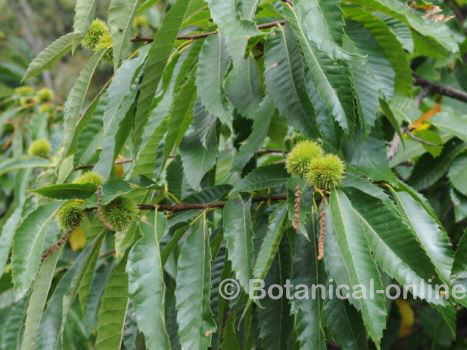 Leaves and fruits of chestnut tree
Chestnuts cooking helps the processing of carbohydrates and converts them into a more palatable food, avoiding the appearance of flatulence that normally accompanies the ingestion of raw nuts. When chestnuts are cooked, the skin can be removed more easily.
How to eat chestnuts
The most common way is cooking them is roasting them on an iron plate or pan. Previously, a cut must be done in their skin to prevent them from exploding. As they are being roasted, they must be removed continuously so as not to burn them. They should not be eaten too hot.
Roasted chestnuts are usually sold in winter, during Christmas, in the streets of big cities by people who have a chestnut booth on the sidewalks of major streets. If cooked well, they are very tasty and aromatic.
Boiled chestnuts
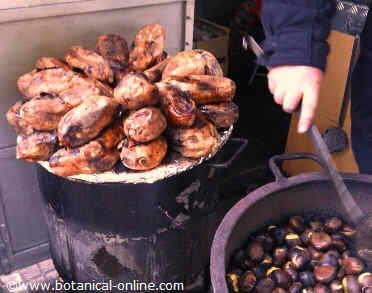 A stand selling roasted chestnuts and sweet potatoes, both delicious natural foods in autumn
Another way to prepare them is in a pan of boiling water. To do this, as in the roasted chestnuts, we must cut them slightly and leave them in boiling salted water for three quarters of an hour. Later, when they have cooled, their crust must be removed.
There are also those who make them candy, boiling them with cinnamon stick, lemon peel and some carminative herbs (cumin, fennel, aniseed, …), to avoid the gases and to be more digestive.
Subsequently, when they are cooled, the bark is removed and eaten whole, crushed or ground.
Chestnuts as a garnish of different recipes
No less interesting are the chestnuts when prepared as accompaniment with fish or meat, as a garnish.
Chestnuts can replace potatoes in many stews and recipes, providing a distinct aroma, a very palatable texture and a delicious flavor.
What are “pilongas”chestnuts or dried chestnuts?
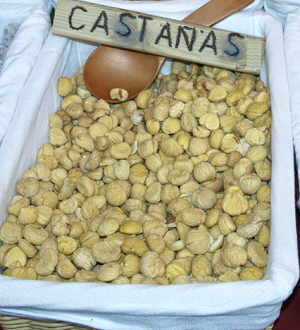 Chestnuts peeled and dried to smoke, known as pilongas chestnuts. They can be bought in many markets and food stores.
Chestnuts peeled and dried to smoke, are known, in Spanish, as “pilongas” chestnuts. They can be bought in many markets and food stores.
“Pilongas” chestnuts are properly peeled, cooked and dried chestnuts. Nowadays, in some places, those chestnuts that can be easily peeled are also called “pilongas” chestnuts. There are many recipes to prepare this type of chestnuts, but almost none of them respond to what has traditionally been called “pilongas”.
How are “pilongas” chestnuts prepared?
The authentic “pilongas” chestnuts were prepared in Galicia (Spain). The traditional method was to place the fresh chestnuts in dryers where the chestnuts were drying.
In the lower part of the dryers fire was made and the chestnuts were placed on the embers so that the heat and the smoke baked them.
Once cooked, the outer skin should be removed. To do this, the cooked chestnuts were placed inside a sack and beat against a tree stump so that the bark was detached. Finally, the impurity of the pilonga chestnuts had to be separated. For this, they were screened using the force of the wind.
This process involved the loss of water and tannins, and the conservation of most of the other nutrient components of chestnuts. In this way, the fresh chestnut, which is very indigestible, became much more digestible and very rich in nutrients, at the same time that the process allowed its conservation. Nowadays, this process is still maintained in many parts of Galicia.
HOW TO BUY THE BEST CHESTNUTS
Selecting and buying chestnuts
When buying chestnuts in the market, it is important to choose those with smooth skin, free from blemishes or cuts and firm to the touch.
These are collected from October to December. In addition to the raw or roasted chestnut, we can use those that are sold fresh or canned and sweetened.
Particularly famous are the ” Marrons glacés“, covered with egg and sugar glaze.
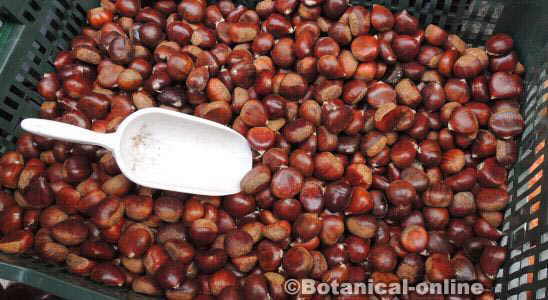 Chestnuts sold in a market
How to store and preserve chestnuts
Tender chestnuts should be stored in a cool, dry place outdoors. They should not be kept in waterproof bags because they can oxidize. Stored in the fridge, they can hold up to 1 month at room temperature or up to four months if they are frozen with the crust.
Dried chestnuts can be stored in the refrigerator for a couple of months.
Can chestnuts be frozen?
Yes. if they are frozen and stored in sealed container, they can be kept up to half a year. To retrieve them, they should be immersed in water for an hour before cooking. This process, in addition to thaw them, allows them to hydrate and recover their original state.
Cooked chestnuts endure three to four days in the refrigerator and, if frozen and stored in an airtight container in the freezer, they can hold up to nine months.
| Composition of the chestnuts by each 100 gr. | |
| Water | 48, 6 g |
| Energy | 213 Kcal |
| Fat | 2, 26 g |
| Protein | 2, 42 g |
| Carbohydrates | 45, 54 g |
| Fiber | 8, 1 g |
| Potassium | 518 mgs |
| Phosphorus | 93 mgs |
| Iron | 1, 01 mgs |
| Sodium | 3 mgs |
| Magnesium | 33 mgs |
| Calcium | 27 mgs |
| Copper | 0, 44 mgs |
| Zinc | 0, 52 mgs |
| Manganese | 0, 95 mcg |
| Vitamin C | 43 mgs |
| Vitamin A | 28 UI |
| Vitamin B1 (Thiamin) | 0, 238 mgs |
| Vitamin B2 (Riboflavin) | 0, 168 mgs |
| Vitamin B3 (Niacin) | 1, 179 mgs |
| Vitamin B6 (Pyridoxine) | 0, 376 mgs |
| Vitamin E | — mg |
| Folic acid | 62 mcg |
 More information on chestnuts and chestnut tree.