Contents
- 1 Health benefits of green tea (Camellia sinensis (L.) Kuntze)
- 2 Medicinal properties of green tea
- 2.1 Tea as a medicinal plant
- 2.2 Tea and its astringent properties
- 2.3 Green tea the only one with EGCG, a powerful antioxidant
- 2.4 Green tea against cancer
- 2.5 Green tea to protect the liver
- 2.6 Green tea as a neuroprotector
- 2.7 How to drink tea to protect the nervous system?
- 2.8 Green tea and its slimming properties
- 2.9 Diuretic properties of green tea
- 2.10 Other medicinal uses of green tea
- 2.11 Green tea as a stimulant drink
- 2.12 Preparations of green tea for external use
- 3 Green tea as a beverage
- 4 How safe is green tea?
- 5 How is green tea used?
Health benefits of green tea (Camellia sinensis (L.) Kuntze)
Characteristics of green tea
Common English noun: Tea
Common name in other languages:
– Spanish/Español: Té verde
– French/Français: Thé vert
– Catalan/Català: Te verd
– Basque/Euskara: Te berdea
– Galego/Galician: Té verde
– Portuguese/Português: Chá-verde
– Italian/Italiano: Tè verde
– Romanian/Româna: Ceai verde
– Magyar/Hungarian: Zöld tea
– Dutch/Nederlands: Groene thee
– German/Deutsch: Grüner Tee, Grüntee
– Polish/Polski: Zielona herbata
– Danish/Dansk: Grøn te
– Norwegian/Norsk bokmål: Grønn te
– Finnish/Suomi: Vihreä tee
– Swedish/Svenska: Grönt te
– Russian/Русский: Зелёный чай
– Türkçe/Turkish: Yeşil çay
Scientific noun: Camellia sinensis (L.) Kuntze
– Synonyms: Camellia theifera Griff.= Thea sinensis L.
Family. Tea family. Theaceae.
Habitat: Native from the South of China, it appears cultivated as a bush of about 2,5 m, in the high areas of Asia and China with a warm and humid climate.
Botanical description of tea plant
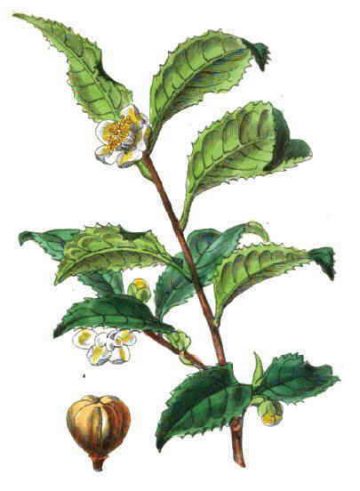
Perennial tree of the tea family – Theaceae – up to 9 m.. Lanceolate or elliptic leaves, short petiolated, 5 -6 cm long; the younger ones downy; the older ones glabrous. Lonely white or cream flowers, sometimes paired in the axils of the leaves that hang from short stems. Fruit in capsule with a single seed.
The variety Camellia sinensis assamica, from India, presents longer leaves and a superior height to the Chinese variety Camellia sinensis sinensis.
Active components of green tea
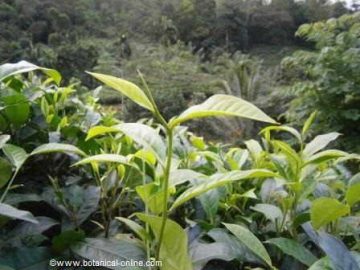
The main components are:
- Amino acids: theanine, valine, arginine, asparagine, glycine, leucine, niacine lysine, histidine
- Acids: Ascorbic (vitamin C), nicotinic (Vitamin B) (leaves); caffeic, chlorogenic, cinnamic, phenylacetic, gallic, malic, oxalic (leaves) lauric, linoleic
- (seeds)
- Alkaloids: Caffeine (leaves and, specially, tender stems) y theobromine (leaves)
- Quercetin
- Rutin
Polyphenols: catechins: epicatechin, epicatechin- gallate, epigallocatechin- gallate. (leaves) Green tea is the only source of epigallocatechin gallate, the major catechin type of antioxidant. Some dietitians recommend the ingestion of green tea extract (especially epigallocatechin gallate) for the body to get the catechins that are necessary. Daily doses of catechins are between 125 and 250 mg daily. It is supplied as a powder, sachets, capsules, etc.
- Carvacrol, geraniol (leaves)
- Fiber (Leaves) : pectin (leaves)
- Minerals: sulfur, calcium, copper, iron, magnesium, phosphorus, potassium,
Varieties of tea
All the varieties of tea derive from two:
- The one that comes from the Chinese species Camellia sinensis sinensis
- The variety that comes from the Hindu state of Assam, Camellia sinensis assamica.
What is the difference between black tea and green tea
From the above two different varieties of tea, it is produced what is known as black tea and green tea.
Black tea results from the fermentation of the leaf. In black tea, oxidase enzyme acts on the polyphenols producing its oxidation and transforming them in compounds that present a brownish coloration.
In green tea the process of fermentation is stopped by means of the heat that destroys the oxidizing enzyme, so the resulting product possesses some unequal characteristics in its composition, flavor, scent and aspect.
By not permitting the enzymes to act, the dry plant of green tea continues maintaining a green aspect, producing the green tea.
Which is better, green tea or black tea?
Both types of tea maintain the same stimulating, digestive and circulatory properties., but the anticancerous properties related with the green tea, and attributed fundamentally to the polyphenols, that are eliminated in the process of fermentation to what the black tea is subjected. This makes that, from a phytoterapeutic point of view, it becomes more advisable to use green tea.
Medicinal properties of green tea
Tea as a medicinal plant
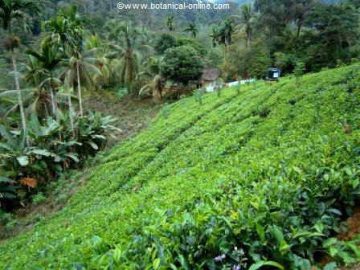
Green tea (Camellia sinensis) is a plant known throughout the world, since ancient times, as its infusion is one of the most popular, exquisite and delicate drinks. From a curative point of view , tea stands out because it contains many tannins, astringent components with great antiseptic properties against diarrhea and infections.
In addition, modern research has found in this plant one of the most potent antioxidants that exist: the epigallocatechin-3-galata (EGCG). This natural antioxidant is being investigated for its properties as neuroprotective and anti-inflammatory of the brain, in diseases as complex as Alzheimer’s or multiple sclerosis. In addition, it has effects on the decrease of cholesterol, as a protector of the liver and depurative.
Tea and its astringent properties
Tea tannins are astringent, dry mucous membranes, are antidiarrheal and have a slight antiseptic effect. Tannins combine with mucosal proteins, preventing the growth of bacteria. They also bind to certain heavy metals and other substances such as alkaloids, which is why they have sometimes been recommended as an antidote.
In cases of intestines too prone to excessive defecation, green tea is useful for stopping diarrhea. In low doses it has a beneficial effect on the stomach.
To prepare an infusion of astringent tea, it must be infused in boiling water and left to stand for longer than usual, about 10-12 minutes. In that time the tannins are released and it is a more astringent drink.
Green tea the only one with EGCG, a powerful antioxidant
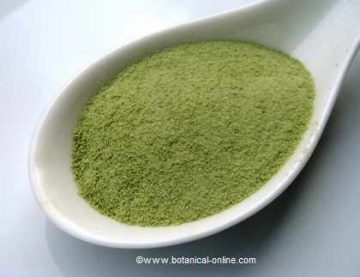
Green tea is very rich in tannins and polyphenols with antioxidant properties. Among them is its epigallocatechin gallate (EGCG) content, which is one of the most potent antioxidants ever found in any plant.
The importance of green tea as an anticancer has been highly valued, a factor that differentiates it from other types of tea and coffee, making it more advisable to take it habitually.
In this sense it is considered that green tea has powerful antioxidant properties, which makes it an authentic medicine that prevents the formation of diseases related to aging and oxidative stress: arteriosclerosis, cholesterol, poor circulation, dementia, and even many types of cancer.
It is recommended to take green tea those people subjected to high stress, smoking and as a stimulant drink for athletes.
Green tea against cancer
Among the components that tea has against cancer are the catechins and especially the epigallocatechin gallate. But, in addition to these flavonoids, we must mention other components considered as tumor inhibitors such as, for example, caffeine, amino acids, quercetin and vitamin C. These same properties could be useful for the treatment of AIDS.
Green tea to protect the liver
Green tea has been extensively researched as a protector of the liver. Its antioxidant properties can protect the degeneration of the liver and help prevent liver cancer or cirrhosis. This property makes it very interesting in the protection of the liver against possible degeneration caused by hepatic steatosis (fatty liver), food poisoning or chemical intoxication.
In addition, it has been proven that it exerts an antiviral action on the liver, making it suitable for the treatment of hepatitis. (Drink green tea daily, type Gunpowder or matcha tea of good quality, infuse and let stand for 10 minutes) (Supplements with tea extract rich in epigallocatechin galata 400 mg EGCG, twice a day)
Green tea as a neuroprotector
Green tea extract rich in epigallocatechin gallate (EGCG) is a very important substance in the field of research on diseases that affect the nervous system. It has been observed that inflammation in the brain decreases by an immunomodulatory effect and increases the levels of N-acetyl aspartate in the brain (marker indicative of better integrity of axons and neurons).
- Enhance memory: The flavonoid naringenin and choline promote circulation and are very useful for enhancing memory.
- Alzheimer’s: Tea contains polyphenols, among which is epigallocatechin-3-galata, which is one of the most potent antioxidants known. Studies have shown that this component is able to improve the cognitive response of Alzheimer’s patients. Epigallocatechin gallate induces apoptosis of the cells responsible for Alzheimer’s progression. (Drink quality green tea daily, Gunpowder type Infuse and let stand 10 minutes) (Concentrated tablets of tea extract with epigallocatechin gallate.
- Down syndrome: is the research with tea extract. The 3-month supplementation with epigallocatechin gallate combined with cognitive stimulation improved learning ability.
- Multiple sclerosis (MS): According to the latest review of scientific studies on complementary therapies for multiple sclerosis (2015), after lipoic acid, another very interesting plant for the treatment of this disease is green tea. In studies on MS, it has been observed that EGCG can help decrease atrophy of the nervous system.
How to drink tea to protect the nervous system?
You should drink quality green tea daily, Gunpowder type or matcha tea of good quality. Infuse and let stand 10 minutes. Between 2 and 4 cups of these teas are necessary to obtain the beneficial properties of tea.
In studies, concentrated tablets of tea extract with epigallocatechin gallate are usually used in a dose of 400 mg of EGCG, twice a day. (Consult the doctor) (In case of taking this treatment, 3-month analysis is recommended to see TSH and liver status)
Green tea and its slimming properties
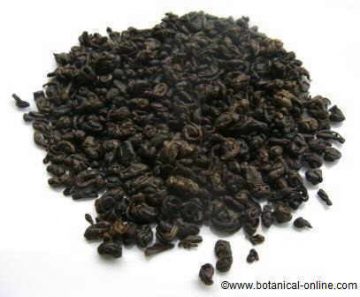
The consumption of green tea has been related to slimming diets due to the role of caffeine (theine) as a stimulant. Recent studies seem to conclude that catechins have a thermogenic effect, that is, they increase body temperature, which, by activating the metabolism, contribute to the subject losing weight. These effects of catechins in green tea increase energy expenditure and the burning of body fat.
It seems that catechins would have a more important role as weight regulators than the same caffeine (theine) of tea. For this reason, people who want to lose weight can help this purpose by taking 1 liter of green tea (infuse and drink during the day, cold or hot).
Diuretic properties of green tea
Because of its stimulant value, it is used as a diuretic in obesity treatments, by increasing urination, removing body fluid. It is also an excellent diuretic and is very suitable to prevent kidney stones and prevent fluid retention.
Following we show you two excerpts from the book “Treatise on the uses, abuses, properties and virtues of tobacco, coffee, tea and chocolate”, written by the surgeon Antonio Lavedan and published in Madrid in 1796. Already at that time the diuretic properties of tea were recommended for rheumatic diseases and to prevent kidney stones:
“When it is necessary to take a strong dose of Tea to produce an abundant evacuation and perspiration, can be administered effectively, and very case a Tea brewing, or a strong infusion, particularly in inflammatory diseases, by the sedative virtue enjoyed by the Tea,aided by the diluting action of hot water; In general it causes perspiration, without stimulating or irritating the nervous system.
It is said that in Japan and China stone sickness is a very rare disease, and these people suppose that tea has the virtue of preventing it; The more so as the water being sweeter and of better quality, it is of better efficiency.”
Other medicinal uses of green tea
- Stimulant: It has a stimulating effect, being very advisable in cheerless spirits, or in those situation when a physical or mental effort is required. One should not overuse it with too much concentrated or repetitive preparations, which might produce irritation in the digestive tract or palpitations.
- Antimigraine: By constraining the pericraneal blood vessels, caffeine, besides being a stimulant, relieves headache, resulting specially interesting with migraine. Caffeine is a component which appears in this plant with the highest proportion and can also be found in other plants as cocoa (Theobroma cacao L), cola (Cola acuminata), and coffee (Coffea arabica L.) and in the flowers of some citrics, such as the orange (Citrus sinensis (L.) OSBECK) or the lemon. (Citrus limon (L.) BURMAN F.)
- Circulatory system diseases: It diminishes cholesterol, makes blood more fluid, energizes the heart and protects it from angina pectoris, arteriosclerosis or heart attack. Histidine constitutes a good antiarteriosclerotic. Theanine, an amino-acid that can only be found in this plant, realizes the same function, beside avoiding the formation of thrombus or blood clots, a property also accomplished by eugenol. Theobromine is a vasodilator and cardiotonic. It can be found in other plants in greater proportion, such as in cocoa (Theobroma cacao L) and cola (Cola acuminata), also in coffee (Coffea arabica L.), but in less proportion than in tea.
- Hair loss: For its silica content, green tea is adequate to keep hair in good condition, treating seborrhea or dandruff , preventing baldness or dry hair (Infusion of a spoonful of dried plant per cup of water. Take one cup a day)
- Fertility: For its wealth of arginine appears to have an influence in increasing sperm (Infusions of the dried plant, type gunpowder)
Green tea as a stimulant drink
Tea contains caffeine, although in less quantity than coffee. Therefore it turns out to be a slightly stimulating drink, suitable in those decayed states of mind or in situations in which an additional physical effort is required.
It is very suitable in times of examinations or a lot of stress, when you need to be stimulated, attentive, concentrated or active. Taking green tea produces these effects while taking antioxidant compounds that help to compensate for stress.
It is not advisable to abuse very concentrated or repetitive preparations, because, in this case, it can lead to irritation of the digestive system as well as produce heart palpitations.
Preparations of green tea for external use
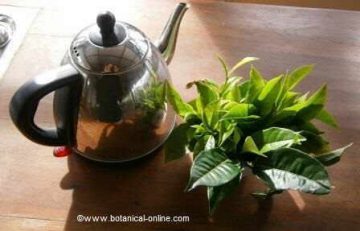
- Halitosis, gingivitis and caries: Because of its antibacterial properties it is suitable to eliminate bad breath, and to protect the mouth against infections produced by the inflammation of gingiva. Its germicide power is used by the industry as a component of many tooth pastes.
- Mouth sores: Because of its bacterial properties, it is adequate to eliminate bad breath and protect the mouth against infections that cause inflammation of the gums or mouth ulcers. (Perform rinses with a well loaded infusion of the dried plant. Perform mouthwash mixed with the infusion of tea and sage or strawberry leaves. You can also place a wet tea bag on the sore right)
- Conjunctivitis: It diminishes inflammation and rest your eyes. (Wet compresses with the infusion of a spoonful of dried plant per cup of water). (A good trick to relax your eyes and prevent the redness caused by conjunctivitis is to apply on your closed eyes for 10 minutes a soaked warm bag of a tea after having prepared the infusion)
- Tired eyes and bags under the eyes: Apply the above treatment.
- Sjogren’s syndrome: Due to its bacterial properties, it is adequate to eliminate bad breath and protect the mouth against infections that cause inflammation of the gums. At the same time, it produces an increase in saliva. (Make mouthwashes with the infusion of the dried plant. Perform mouthwashes with the mixed infusion of tea and sage leaves or strawberry) (Drink the liquid)
- Vaginitis: the tannin-wealth of green tea can be used to deflate the irritated area. (Make an infusion of a couple of tablespoons of dried plant per half liter of water. Allow it to cool and clean the part where there is itching, redness or stinging.)
- Sunburn: To cure sunburn when these affect the eyelids, tea bags can be used Dip the bag in cold water and apply to the sunburned eyelids.
- To disguise the gray hair: tea infusions darken the hair so it can be used as natural hair dyes.
Green tea as a beverage
Green tea is the most consumed infusion worldwide over coffee. It is known not only for its medicinal value, but as social or family drink served at parties, meetings, etc.
The British have made a tradition use and ” Tea time ” is one of the moments of gathering around the table daily. Also for the Japanese is part of their rites. In India, it is an infusion of everyday use. It combines well with cookies and milk, which does not take away any of its medicinal properties and adds a unique flavor.
Lately it has been introduced in the world of youth, mixed with alcoholic beverages, something not advisable because this converts these products into too stimulating mixtures.
Green tea is one of the 50 fundamental herbs of Chinese Medicine.
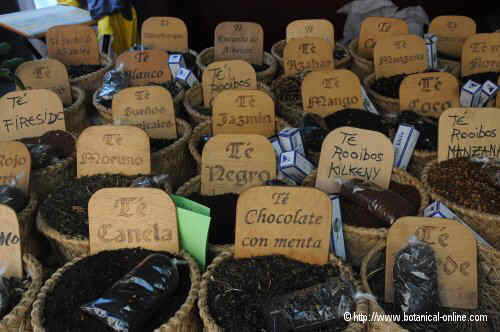
Photo of different varieties of tea in a market
How safe is green tea?
Green tea, in regular use, has no toxicity, but it has a number of contraindications and side effects, that should be taken into account. (More information in the listing below)
How is green tea used?
Buy a good quality green tea
To obtain the properties of green tea, it is necessary to use a first quality material. The authentic green tea will have to be bought in specialized stores and for an affordable price. One of the best is Gunpowder green tea.
Tea bags that contain dust are not recommended. Since the tea is so crushed, its components have been oxidized.
Dosage of green tea
- Infusions: from 2 to 3%, the equivalent to one teaspoon per cup.
- Stimulant infusion: If what is intended is to enhance the stimulating value of caffeine, it is advisable to make an infusion in a short period of time of about 3 minutes.
- Astringent infusion (more antioxidant but less stimulating): If you want to extract the astringent values, it is advisable to prolong the infusion for a longer time, up to 10 or 12 minutes.
In the second case, the stimulating value of caffeine is practically nullified because the polyphenols released during the resting of the infusion are complexed with it and slow down its assimilation.
*Related information on green tea:
– Green tea differences with black tea
 More information on tea.